
Fibre
(3 minute read)
Fibre, a pillar of good nutrition, has found its way back into wellness conversations. This renewed attention is driven by a rise in colorectal cancer among young people, a trend linked to low fibre intake.
Colorectal cancer is cancer that develops in the colon (large intestine) or rectum, which make up most of the large bowel. Rates of early-onset disease have become a global phenomenon, with incidence rates among people under 50 doubling over the past 30 years. ¹ Rises are seen in both high-income and developing countries, with some of the steepest inclines seen in England. This increase is largely attributed to environmental factors such as diet, physical activity and obesity.
Fibre intake has been consistently linked to a reduced risk of colorectal cancer. The rise of ultra-processed foods, which have increasingly displaced nutrient-dense, high-fibre whole foods, has been partly linked to the growing rates. While diet and fibre are not the only factors at play, they have been identified as among the key risk factors. ³
What is fibre?
Dietary fibre is part of the plant material that is resistant to digestion in the human small intestine. It is generally divided into two types based upon its ability to dissolve in water; soluble and insoluble fibre. Soluble fibre is able to dissolve in water to form a gel-like substance in the gut, which supports healthy digestion, blood sugar regulation and cholesterol levels. Whereas insoluble fibre is unable to be broken down by the digestive system and instead passes through the gut, adding bulk to stool and supporting regular bowel movements.
Dietary fibre is defined by what escapes digestion in the small intestine, rather than simply coming from a particular type of plant food. Unlike regular starch, resistant starch is not broken down and absorbed in the small intestine, instead reaching the large intestine where it can be fermented by gut bacteria. This process produces short-chain fatty acids, which promote the growth of beneficial bacteria in the gut microbiome, whilst inhibiting the growth of harmful bacteria. ⁴
This is why some fibres are described as having prebiotic effects. Prebiotics are substances that support the growth and activity of beneficial bacteria in the gut. It is generally accepted that there are broader health benefits to eating fibre, particularly in supporting the gut microbiome, compared with taking prebiotic supplements. ⁵
How is it linked to disease prevention?
Fibre has been consistently linked to a reduced risk of colorectal cancer, with research suggesting that its protective effects are partly due to how it interacts with the gut. Short-chain fatty acids, including butyrate, help maintain the health of the cells lining the colon, reduce inflammation and support the gut barrier. ⁶
As mentioned, fibre also increases stool bulk and helps speed up bowel movements, which reduces the amount of time harmful compounds can be in contact with the intestinal lining.
Research has repeatedly shown an association between higher fibre intake and a lower risk of colorectal cancer. A large systematic review and meta-analysis found that each additional 10 g of dietary fibre consumed per day was associated with around a 10% lower risk of colorectal cancer. ⁷
Recommendations & guidelines
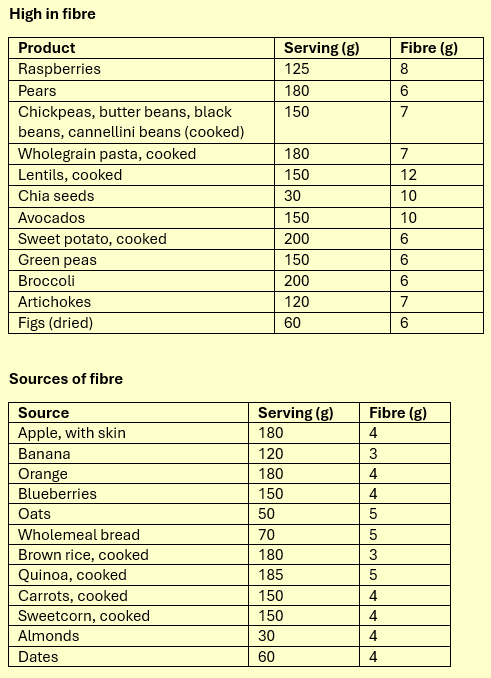
Adults are recommended to consume 30g of fibre per day from a variety of sources which gives the digestive system and gut microbiome a broader range of benefits. If this isn’t already being achieved, becoming slightly more intentional with food choices can make this realistic. The British Dietetic Association (BDA) recommends building up fibre intake gradually to avoid gastrointestinal upset. ⁸
Foods containing at least 6 g of fibre per 100 g are considered high in fibre, while those containing at least 3 g per 100 g are considered a source of fibre. Intentionally adding a couple of these foods into each meal easily builds into the recommended intake.
A day of fibre-rich eating
Breakfast:
Greek yoghurt (200g) with almond butter (15g), raspberries (60g), chia seeds (5g) and banana (80g)
Lunch:
Roasted chickpeas (60g) and sweet potato (120g) on a bed of mixed salad leaves with broccoli (100g) and chicken or halloumi (150g/100g)
Snack:
Almonds (15g) and dried dates (20g)
Dinner:
Brown rice (180g cooked) and salmon (120g), with edamame (50g), cucumber (50g) and avocado (20g)
Daily total: 30g of fibre
* Portion sizes should be adjusted to suit individual energy needs; this example is intended to illustrate fibre content
Additional adjustments
Keep frozen berries for easy daily accessibility
Tinned beans and pulses are economical and fibre-rich; roast with olive oil, salt, paprika and garlic for meal preparation or as a salad topping
Choose wholemeal over white carbohydrates
Leave the skins on fruit and vegetables
Eat and blend fruit, juicing removes the pulp and with it, the fibre
References:
1. International Agency for Research on Cancer. ECCE: About [Internet]. Lyon: IARC; 2026 [cited 2026 Aug 15]. Available from: https://ecce.iarc.who.int/about/
2. Sung H, Siegel RL, Laversanne M, et al. Colorectal cancer incidence trends in younger versus older adults: an analysis of population-based cancer registry data. Lancet Oncol. 2025;26:51-63.
3. Carroll KL, Frugé AD, Heslin MJ, Lipke EA, Greene MW. Diet as a risk factor for early-onset colorectal adenoma and carcinoma: a systematic review. Front Nutr. 2022;9:896330. doi:10.3389/fnut.2022.896330.
4. Dhingra D, Michael M, Rajput H, Patil RT. Dietary fibre in foods: a review. J Food Sci Technol. 2012;49(3):255-266. doi:10.1007/s13197-011-0365-5.
5. Walsh SK, Armet AM, Nikolaeva DD, Mota JF, Lucey AJ, Oliero M, et al. Optimizing dietary fiber intake: strategies for human nutrition and food science. Annu Rev Food Sci Technol. 2026;17(1):25-50. doi:10.1146/annurev-food-052824-044842.
6. Hamer HM, Jonkers D, Venema K, Vanhoutvin S, Troost FJ, Brummer RJ. Review article: the role of butyrate on colonic function. Aliment Pharmacol Ther. 2008;27(2):104-119. doi:10.1111/j.1365-2036.2007.03562.x.
7. Aune D, Chan DSM, Lau R, Vieira R, Greenwood DC, Kampman E, et al. Dietary fibre, whole grains, and risk of colorectal cancer: systematic review and dose-response meta-analysis of prospective studies. BMJ. 2011;343:d6617. doi:10.1136/bmj.d6617.
8. British Dietetic Association. Fibre [Internet]. Birmingham: British Dietetic Association; 2021 [cited 2026 Aug 16]. Available from: https://www.bda.uk.com/resource/fibre.html